Where VIP Flight Attendants Lose Time - And the Planning System That Wins It Back
- Apr 14
- 6 min read
Updated: May 29
A senior VIP Flight Attendant's account of where time really goes, and the operational habits that protect your rest, your standards, and your professional reputation.
The Time Problem Nobody Prepared You For
Flight attendant training covers a great deal. Safety protocols. Service standards. Emergency procedures. Cultural awareness. Communication.
What it rarely addresses with any precision is the time management reality of working in private aviation, specifically, the way that planning, preparation, and provisioning consume not just your working hours, but your rest time.
"A lot of time is spent on planning, which could be before the flight or in between stops. Most of the planning is done in their own time, thus it eats into their rest time." — Corrine, Senior Flight Attendant, 25+ years in private aviation.
For crew transitioning from commercial to private aviation, or for those early enough in their careers that the full scope of the role is still revealing itself, this comes as a genuine surprise.
In commercial aviation, you arrive, you brief, you board, you serve. The planning infrastructure exists around you.
In private aviation, you are the planning infrastructure.
Where VIP Flight Attendants Lose Time: The Anatomy of Lost Time
Before examining solutions, it is worth mapping the problem precisely. Corrine's experience identifies several distinct categories of time loss.
Caterer Selection and Menu Planning
"It's mostly assessing catering recommendations and reviewing food menus, which can be time consuming." — Corrine
For a single rotation, a conscientious flight attendant might spend up to 90 minutes reviewing catering suppliers and menu options, cross-referencing against known passenger preferences, checking supplier availability, and constructing a catering brief that reflects the flight's requirements accurately. On a multi-leg rotation across several days, this compounds significantly.
The challenge is that this work cannot easily be compressed. Rushed menu planning produces rushed catering briefs, which produce variable results. This ultimately costs more time in service recovery than the planning shortcut saved.
Equipment Readiness & Items Adjustments to Service
"When flight attendants purchase items themselves, they must repackage them for proper presentation or prepare dishes like fruit salad, additional work that pre-ordered catering would eliminate." — Corrine
The crew member who sources premium ingredients independently, or who receives catering in supplier packaging that doesn't work in the galley, often finds themselves doing real kitchen preparation work in circumstances that are not designed for it.
Last-Minute Changes
The disruption of a last-minute change, such as a passenger dietary requirement communicated at short notice, a departure time moved forward, or an additional passenger added to the manifest. This does not simply add time to the pre-flight process.
It resets elements of the planning that have already been completed, requiring not just additional work but the mental overhead of restructuring an existing plan under time pressure.
Download: The Last-Minute Change Response Card
A laminated quick-reference card for managing disruptions before and during flight, including:
|
The Last-Minute Change Protocol
Last-minute changes are not exceptional events in private aviation. They are structural features of the operational environment. The aircraft follows the principal's schedule, which changes. The passenger list shifts. Dietary requirements surface late.
Corrine's experience reflects a principle that experienced crew members internalise relatively early: the goal is not to prevent last-minute changes, it is to have a system that absorbs them without collapsing.
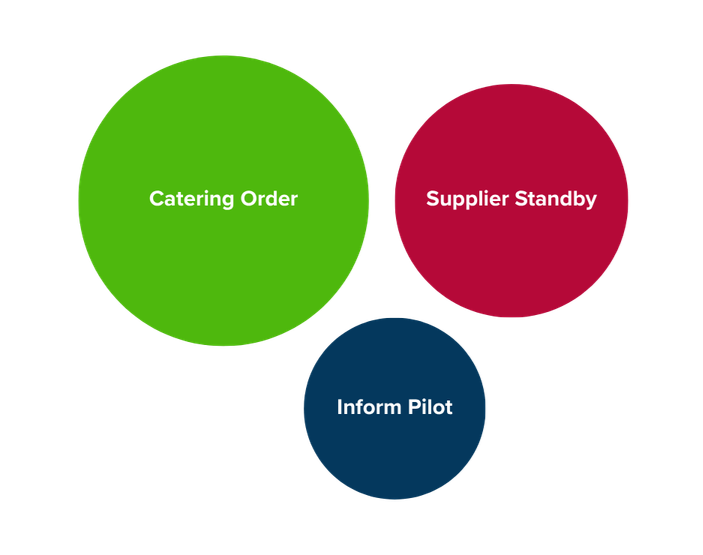
Each component of this system is independently valuable, together, they create an operational resilience that distinguishes senior crew from those still reacting to disruption rather than managing it.
The Operational Components of That System
Maintain a Catering Order Buffer Build a change buffer into galley provisioning, flexible items that can be adapted to accommodate different services without requiring an external order. | Have Your Supplier on Standby For crew with established Tier 1 supplier relationships, the lastminute change conversation is a matter of minutes rather than a research process. | Keep the Pilot Informed Immediately The moment a significant change lands, the pilot needs to know — not because the pilot manages the catering, but because integrated communication allows the operation to adapt coherently. |
Maintain a Catering Order Buffer
Experienced crew build a "change buffer" into their catering order provisioning, items of sufficient flexibility that they can be adapted to meet a shifted requirement without requiring an external order. This is not a simple task — the catering order buffer only works if you plan items that can move across several services without appearing repetitive or inadequate.
Versatile buffer items:
Fresh Fruit
Quality Cheese
Good Bread
Neutral Accompaniments
Pre-made Sandwiches (breakfast, lunch, or light dinner)
Quality Cakes or Pastries (breakfast, dessert, or afternoon service)
The key principle: Provisions that work for breakfast, as a snack, as a light lunch element, or as a late-evening offering without requiring galley transformation. The passenger who is added to the manifest at the last moment can always be served well if the catering order buffer is thoughtfully stocked with items that are ready to plate across multiple service contexts.
Have Your Supplier on Standby
Tier 1 suppliers aren't just about quality — they're about operational partnership. A 5-minute call replaces a 30-minute research cycle because the relationship and trust are already established. Modern catering platforms take this further: flight attendants can rely on a 24/7 customer service team when they organise their catering orders through online platforms—meaning last-minute adjustments, clarifications, or urgent requests don't require crew to absorb the coordination stress during rest periods. The platform's dedicated team handles supplier liaison, order confirmation, and issue resolution around the clock. This isn't delegation. It's systematic time protection.
Without Established Relationships Research, vetting, briefing, and follow-up for an unknown supplier. Time-consuming, quality uncertain, and stressful under pressure. | With Tier 1 Supplier Relationships A five-minute call. The supplier knows your standards. The change is absorbed. The service is protected. |
Check With Pilot for Additional Changes
The moment a significant change lands — one that affects catering spend (where the pilot is responsible), departure timing, or passenger requirements — check with the pilot for any additional information on the flight change. Not because the pilot manages the catering logistics, but because the flight deck often has operational context that the cabin doesn't: updated departure windows, routing adjustments, or principal schedule shifts that haven't yet filtered through to crew briefings. This integrated communication across flight deck and cabin is what allows the operation to adapt coherently rather than in parallel.
Where Does the Time Actually Go? An Honest Breakdown
For crew who have not tracked their time formally, the distribution is often surprising as to where VIP flight attendants lose time.
Based on Corrine's account and broader senior crew experience, a typical pre-flight planning window breaks down as follows:
Activity | Estimated Time | Time Reclaim Potential |
Caterer and menu research | 45 - 90 minutes | 🔴 High (templates / tools) |
Supplier brief draft | 20 - 40 minutes | 🔴 High (templates / tools) |
Supplier communication | 15 - 30 minutes | 🟠 Medium (relationship) |
Catering receipt and inspection | 20 - 30 minutes | 🟢 Low (fixed requirement) |
Galley setup and organisation | 30 - 45 minutes | 🟠 Medium (system) |
Packaging and presentation | 30 - 60 minutes | 🟠 Medium (supplier choice) |
Passenger preference review | 15 - 30 minutes | 🟢 Low (fixed requirement) |
Last minute adjustments | 15 - 45 minutes | 🟠 Medium (buffer stock) |
Considering the above times, the areas with the highest time reclaim potential - menu research, brief drafting, and supplier communication - are precisely the areas where systematic tools make the most significant difference.
Current Reality 40-minute brief drafting exercise 30-minute supplier research and communication | With Systematic Tools 10-minute personalisation of a template 5-minute phone call with a Tier 1 partner |
This is not a theoretical efficiency gain. It is recoverable rest time.

Protecting Your Rest: The Non-Negotiable
The issue of planning eating into rest time is not simply a productivity concern.
In private aviation, where duty periods can be long and consecutive, where time zones change mid-rotation, and where the standard of service is expected to remain constant regardless of operational circumstances, crew fatigue is a safety matter as well as a service quality matter.
Whose Rest is Protected? | How? | The Impact? |
The pilot's | Regulated, documented, and enforced. | 🔴 High |
The flight attendant's | In many operational contexts, managed primarily by the flight attendant themselves. | 🔴 High |
This makes the following a professional imperative rather than a personal preference: the time you reclaim through systematic planning is rest time, and rest time is not a luxury. It is what allows you to deliver the standard of service that defines your professional reputation, flight after flight, rotation after rotation.
The flight attendant who is planning menus at midnight in a hotel room in an unfamiliar city is not demonstrating dedication.
They are depleting a resource that cannot easily be replaced.
The system and tools exist to protect you. Use them.
Download: The Last-Minute Change Response Card
A laminated quick-reference card for managing disruptions before and during flight, including:
|


